 Hutarka
How to Stop Translating in Your Head
Translation isn't a character flaw — it's a workflow problem. Change what you store and how you practise recall, and the habit fades.
Why does translating make me so slow?
When you translate, every sentence runs a three-step pipeline: think the idea in your native language → convert it word by word → say the result. Direct speakers run one step: idea → English. The pipeline costs you twice:
- Speed. Three steps can't keep up with conversation tempo — by the time your sentence is ready, the moment has passed.
- Accuracy. Word-by-word conversion imports your native language's word order and idioms, producing English that's grammatical in your head and strange out loud.
The fix is not "think faster". It's storing English in bigger units so there's less to assemble, and practising recall from the situation instead of from your native sentence.
What actually replaces translation? Five habits
| Habit | What you do | Why it works |
|---|---|---|
| 1. Learn phrases, not words | Store "Can I have…", "I'm running late", "It's up to you" as single units | A chunk is retrieved whole — nothing to assemble, nothing to translate |
| 2. Narrate your day | Silently describe simple actions in English: "I'm making coffee. The bus is late." | Builds the idea→English path on easy material, minutes per day |
| 3. Recall from situation cues | Ask "what do I say at the counter?" not "how do I say [native sentence]?" | Anchors phrases to moments — the same cue you'll get in real life |
| 4. Use English-to-English lookup | Prefer learner's definitions over bilingual dictionaries once you're past A2 | Keeps you inside English instead of hopping languages |
| 5. Accept simpler sentences | Say the B1 sentence you own, not the C1 sentence you'd translate | Fluency grows from produced sentences, not perfect ones |
Habit 1 is the multiplier. Linguists estimate a large share of everyday native speech is prefabricated chunks reused verbatim — natives aren't building most sentences either; they're retrieving them. Matching that strategy is more realistic than out-computing it.
How long does it take?
With daily practice, most learners notice simple thoughts arriving directly in English within a few weeks — greetings, orders, routine exchanges first. Complex opinions keep a translation flavour for much longer, and that's fine: the goal is to shrink the translated zone, situation by situation, not to eliminate it overnight.
Hutarka trains exactly this recall
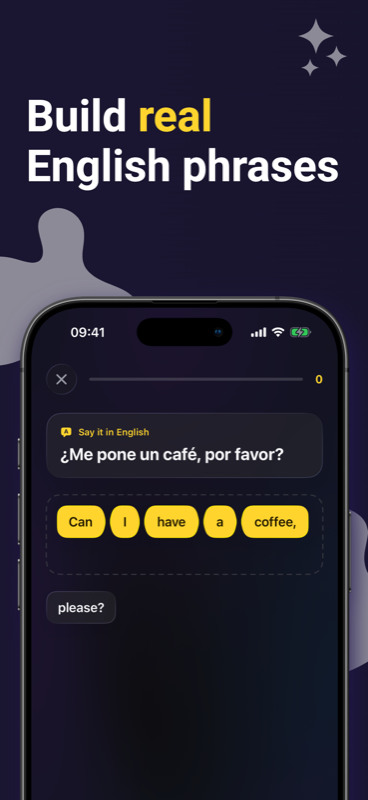
Every Hutarka exercise gives you a situation cue in your own language and makes you build the English phrase word by word — active recall of whole chunks, not recognition or re-reading. That's habits 1 and 3 in app form: "Stop translating in your head. Start knowing what to say."
 Build your first phrases — free
A 10-minute daily drill
- Minutes 1–5: drill one situation pack (coffee, small talk, hotel) — build each phrase from its cue.
- Minutes 6–8: narrate what you're doing right now, out loud if you can.
- Minutes 9–10: replay one real moment from today and say the English version of what you said — or wish you'd said.
The common mistake is doing this once, intensely, for two hours on Sunday. Retrieval strengthens with spacing: ten minutes daily beats two hours weekly, every time.