 Hutarka
English Levels A1 to C1, Explained
CEFR levels sound bureaucratic until you see them in a real sentence. Here's what each level means in everyday speech — and how to pick yours without a test.
What do the CEFR levels actually mean?
The CEFR (Common European Framework of Reference for Languages) describes what you can do in a language, not how many years you've studied. Six levels, three bands: A = basic user, B = independent user, C = proficient user. In everyday terms:
| Level | Name | In a real conversation, you can… |
|---|---|---|
| A1 | Beginner | Introduce yourself, order simply, use memorised phrases if people speak slowly |
| A2 | Elementary | Handle routine exchanges — shopping, directions, simple plans — in short sentences |
| B1 | Intermediate | Deal with most everyday situations, describe experiences, give reasons — with effort |
| B2 | Upper-Intermediate | Speak comfortably with native speakers, argue a point, handle surprises without rehearsal |
| C1 | Advanced | Use language flexibly and precisely — nuance, humour, the right register for the room |
(C2, near-native mastery, completes the framework — but for practical everyday goals, C1 is the summit worth planning for.)
One sentence, five levels
Abstract descriptors hide how gradual the growth really is. Watch a single café request climb the scale:
| Level | Same intent, said at that level |
|---|---|
| A1 | "A coffee, please." |
| A2 | "Can I have a coffee with milk, please?" |
| B1 | "Could I get a medium latte to go, please?" |
| B2 | "Could I get a medium oat-milk latte to go — and could you make it extra hot?" |
| C1 | "Sorry, quick change — could you make that one decaf if it's not too late?" |
Every level orders coffee successfully. What grows is precision, flexibility and the ability to handle the unplanned — not fancier vocabulary for its own sake.
How do I pick my level honestly?
- Think of yesterday, in English. Couldn't have done any of it? A1.
- Could ask for things but not chat? A2.
- Survive everything, but slowly and with mistakes? B1 — the most common self-assessment, and usually right.
- Comfortable, just not precise or natural? B2.
- Fluent and hunting for nuance? C1.
Two rules: when torn between two levels, pick the lower one — confidence from finishing easy material beats drowning in hard material. And your level isn't a tattoo: re-evaluate monthly and move up as soon as a level feels easy.
Every Hutarka situation has phrases at all five levels
Pick A1 to C1 when you start and Hutarka builds a plan that fits — the same real situations, with phrases pitched to your level, so you're always challenged but never lost. Level feels wrong? Change it in your profile any time.
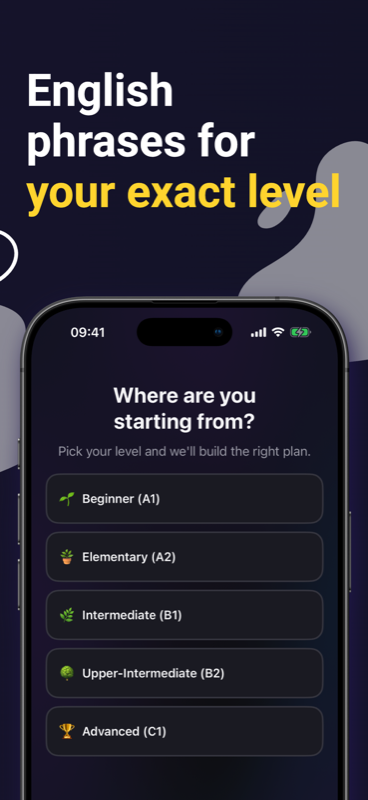 Pick your level in Hutarka — free
Using your level well
A level is a filter, not a grade. Use it to choose material where you understand ~80% and produce the rest with effort — that's the growth zone. At any level, phrase-first practice moves you faster than grammar-first (here's why phrases beat word lists), because levels are measured by what you can do in situations — the same unit you should be practising in. And whatever your level, the enemy is the same: translating in your head instead of retrieving phrases whole.