 Hutarka
Best App to Learn English Speaking: an Honest Guide
There is no single best app — there's a best app for what's blocking you. Diagnose the blocker first; the choice makes itself.
What should a good English speaking app do?
Whatever you install, hold it to this checklist:
- Active production, not recognition. Tapping "which one means X?" is recognition. Speaking needs production: building or saying the sentence yourself.
- Real-life language. The sentences you practise should be ones you'll plausibly say this month.
- Level fit. Material pitched to your CEFR level — too easy bores you out of the habit, too hard scares you out of it.
- A sustainable daily unit. Five to fifteen minutes, or you'll skip it by week three.
- Native-language support if you're A1–B1 — guessing what you're even being asked wastes your practice time.
How do the popular apps compare?
| App | Genuinely great at | Weaker at | Best if… |
|---|---|---|---|
| Duolingo | Habit building — streaks and gamification keep millions practising daily, free | Speaking is scripted and thin; course order, not your situations | …your problem is consistency |
| ELSA Speak | Pronunciation — phoneme-level feedback on your accent | What to say; it coaches sounds, not conversations | …people misunderstand your accent |
| italki | Real conversation with human tutors, personal feedback | Costs per lesson; needs scheduling and courage at low levels | …you need live practice and will pay for it |
| HelloTalk | Free exchange with natives learning your language | Unstructured; quality depends on partners | …you want a practice community |
| Hutarka | Knowing what to say — ~40-phrase packs per real situation, built word by word at your level (A1–C1), prompts in your language | No speech grading or live humans; iOS only; new app, small track record | …you freeze because the words aren't there |
Notice these aren't really competitors — they attack different layers of speaking. A tutor can't help you if you have no phrases to bring; pronunciation polish is pointless on sentences you can't produce; a streak of recognition exercises never becomes speech.
So which one should I get?
- "I understand English but freeze when it's my turn" → your gap is phrase retrieval. A situational trainer (Hutarka) first; add italki when the phrases are there. This freeze is usually the translating-in-your-head habit — fix the storage, not the nerves.
- "People ask me to repeat myself" → ELSA for pronunciation, plus phrase packs so repaired sounds carry real sentences.
- "I can't stay consistent" → Duolingo's habit machinery, or any app whose daily unit fits your life — Hutarka's 10-phrases-a-day goal is built for coffee-break sessions.
- "I have nobody to talk to" → HelloTalk (free) or italki (paid) — and bring prepared situations to every exchange.
A two-app stack — one input/drill app plus one output channel — beats any single app. Keep the total daily commitment under 20 minutes or the stack collapses.
Where Hutarka fits
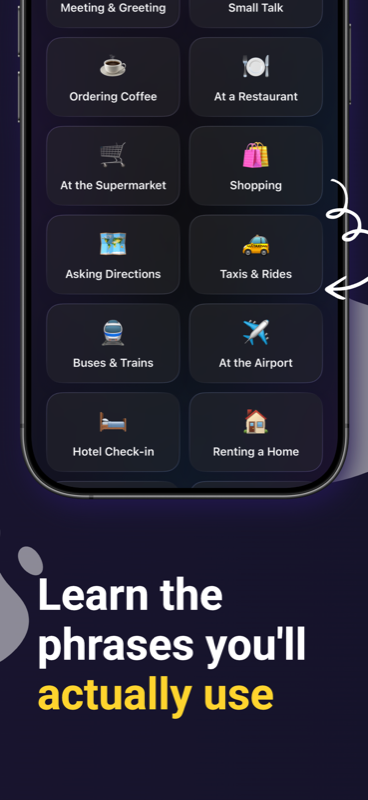
Hutarka is the what-to-say layer: real English phrases for real situations — ordering coffee, hotel check-in, small talk, the airport — drilled by building each sentence yourself, at your level, prompted in your own language. Free on iPhone and iPad.
 Download Hutarka — free
Red flags when choosing
- "Fluent in 30 days" — no method delivers that; distrust the rest of the marketing too.
- Endless recognition quizzes — if you never produce a sentence, you're studying English, not learning to speak it.
- No level control — one-size content fits A1 nobody. (Unsure of yours? English levels A1–C1, explained.)
- Sample the free tier for a week before paying — the best app is the one you actually open on day six.