 Hutarka
How to Make Small Talk in English
Small talk isn't about being clever — it's a small set of reusable moves: open, react, ask, exit. Learn the moves and any topic works.
How do I start a conversation?
The most reliable opener is a comment on the shared situation plus an open question. You're both in the same place — use it:
| Where you are | Opener that works |
|---|---|
| A party or event | "Great turnout, isn't it? How do you know the host?" |
| Work / a conference | "Is this your first time at this event? What did you think of the talk?" |
| A queue or waiting room | "This line is moving slowly today… Have you been here before?" |
| Meeting someone new | "Hi, I don't think we've met — I'm [name]." |
| Anywhere, honestly | "Beautiful day, isn't it? / Crazy weather lately, right?" |
Note the shape: statement first, then question. A bare question can feel like an interview; the statement gives the other person something to agree with before they have to produce anything.
What topics are safe — and which should I avoid?
- Safe: the weather, travel and holidays, food and restaurants, work (what, not how much), films and shows, the event you're both at, weekend plans.
- Avoid with strangers: salary and money, politics, religion, age, weight and appearance, relationship status. These aren't forbidden forever — just not in the first ten minutes.
How do I keep the conversation going?
You don't need long sentences — you need reactions. Native speakers hold conversations together with tiny fixed phrases:
- "Oh really? / No way! / That's interesting."
- "That sounds fun / stressful / amazing."
- "Tell me more about that." / "How did that go?"
- "Same here." / "I know exactly what you mean."
The pattern to remember is react → relate → ask: "That sounds fun (react) — I went there last year too (relate). Which part did you like best? (ask)". Two of these loops and you're officially having a conversation.
How do I end it politely?
- "Well, it was really nice talking to you. I should say hello to a few more people."
- "I'd better get going — great to meet you!"
- "Let's catch up again soon. Enjoy the rest of your evening!"
Positive statement + reason + wish. Ending warmly matters more than ending smoothly — nobody remembers the exit line, only the tone.
Make the moves automatic with Hutarka's Small Talk pack
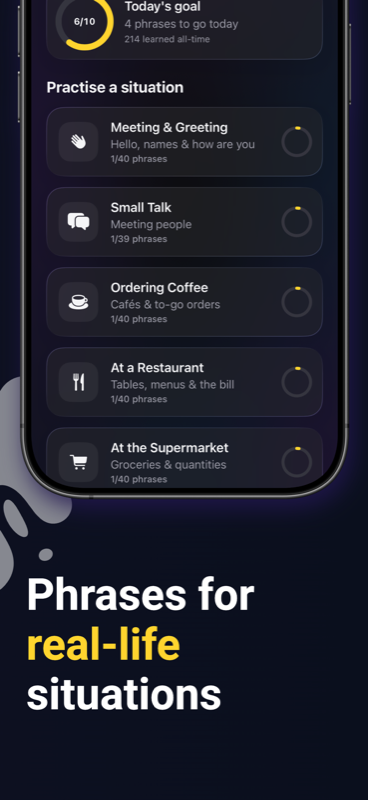
Knowing the moves isn't the same as producing them mid-conversation. Hutarka's Small Talk pack (39 phrases) and Meeting & Greeting pack (40) drill the openers, reactions and exits at your level, A1 to C1 — you build each phrase word by word until it comes out without translating.
 Try the Small Talk pack — free
A practice plan for one week
Day 1–2: memorise three openers (one for work, one for events, the weather one). Day 3–4: drill the react–relate–ask loop with five reaction phrases. Day 5: add two exit lines. Day 6–7: use one opener on a real person — a barista counts (see ordering coffee in English for that script). One genuine exchange teaches more than an hour of silent review, and each rep weakens the translate-first habit.